
Course Work BY R. A. Chaproniere
Navigation
HOMEPAGE
COURSES
 Exploring the Universe
Thu' a Small Telescope
Thu' a Large Telescope
Galaxies
Planetary Atmospheres
Planetary Geology
Modern Cosmology
Stars
Science Fiction???
PROJECTS
Essays
Observational Work
ABOUT ME
CONTACT ME 
Data Source :
Advertisement
 Hubble Reborn takes the reader on a journey through the Universe with spectacular full-colour pictures of galaxies, nebulae, planets and stars as seen through Hubble's eyes, along the way telling the dramatic story of the space telescope, including interviews with key scientists and astronauts.
Astonomy Now

Advertisement
John Moores University offers exciting distance learning courses in Astronomy ranging from an Introduction to Astronomy to Planetary Geology . You are sure to find something that interests you and want to know more about. If, like me, you've a lifelong interest in the subject or have been overwhelmed by the sheer beauty of the heavens then this is the place to start.
John Moores University
Assignment 6 (Craters)

Assignment 6 - Craters
Impacted surface type and density. Where the impacted surface is rocky (similar to the Earth) then the vaporisation point is high meaning that for a given impact energy level more of the ejector is retained. Conversely a surface where the material is say, frozen water then much of the ejector is lost as steam. The density of the impacted material also plays a roll for an impact into bedrock will be quite different from one into a sandy surface which again will be quite different into a liquid.
Nature of Impactor. In general terms they come in two flavours, namely Asteroids and Comets. In turn Asteroids and their fragments can be subdivided into classes; Iron, Stony Iron and Stony. The iron meteorites are perhaps the most dense with the highest energy level for a given size and velocity. There is one other class of impactor that needs to be part of this list and has quite different effects on the impacted surface. Comets with their high water content, large size and high velocity (can be in the region of 1.6 million km/h at perigee) also contain huge amounts of kinetic energy and have the ability of causing massive disruption to an impacted surface. It is suspected that most of the water on planet Earth was shipped in aboard comets. In the case of the above images the Moon’s mean density of 3,346.4 kg/m and, from the findings of the Apollo missions, surface rock not unlike the Earth, means that its vaporisation point is very high. The conclusion is that much of the kinetic energy of the impact is held in the liquefied rock and as cooling takes a relatively long period as it radiates back into space and into the surrounding surface, time is available for the rock on the inside of the crater to self level and produce a smooth terrain. A coherent, high density surface will want to resist deformation from the impact an will try to push back. This will cause the ground on the outside of the crater near the rim to compress and elevate, building noticeable slopes away from the rim. Dione on the other hand with a mean density of 1.095 Kg/m2 and a surface of mainly water ice has a low vaporisation point. The implications are that when a surface like this is impacted the kinetic energy is quickly dissipated into space as water vapour leaving little time for the surface to recover and self level. The chaos of the boiling slurry is almost instantly frozen leaving a rough and uneven terrain. The lower density surface also fails to push back and uplift of the surrounding area adjacent to the rim is much reduced.
12) Have you observed any examples of impact craters of any kind? What were they, and how were they formed? (Craters can be formed by a variety of falling objects, not only meteorites!)
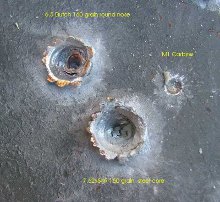 These images demonstrate cratering in every day life. Top
left is of bullets impacting metal and although the kinetic
energy is insufficient to melt the metal for anything but a
very short period, it clearly demonstrates push back with
the outside surface appreciably rising towards the cater
rim. The bottom middle image is of rain drops on a sandy
surface. In the realm of geology a question has long been
asked about the patterns found in some sedimentary
rocks. One of the main contenders to answer this is the
fossilisation of ancient rain drop impacts. We may have
These images demonstrate cratering in every day life. Top
left is of bullets impacting metal and although the kinetic
energy is insufficient to melt the metal for anything but a
very short period, it clearly demonstrates push back with
the outside surface appreciably rising towards the cater
rim. The bottom middle image is of rain drops on a sandy
surface. In the realm of geology a question has long been
asked about the patterns found in some sedimentary
rocks. One of the main contenders to answer this is the
fossilisation of ancient rain drop impacts. We may have
many more craters on the earth than we thought! The
short lived crater in the bottom left image caused by a water
drop into water demonstrates surface rebound, a
cause of central peaks in some craters. For the bottom
right image cause and effect are well known!
Pages
<< | 1 | 2 | 3 | 4 | 5 | 6 | Next | >>