
Course Work BY R. A. Chaproniere
Navigation
HOMEPAGE
COURSES
 Exploring the Universe
Thu' a Small Telescope
Thu' a Large Telescope
Galaxies
Planetary Atmospheres
Planetary Geology
Modern Cosmology
Stars
Science Fiction???
PROJECTS
Essays
Observational Work
ABOUT ME
CONTACT ME 
Data Source :
Advertisement
 Hubble Reborn takes the reader on a journey through the Universe with spectacular full-colour pictures of galaxies, nebulae, planets and stars as seen through Hubble's eyes, along the way telling the dramatic story of the space telescope, including interviews with key scientists and astronauts.
Astonomy Now

Advertisement
John Moores University offers exciting distance learning courses in Astronomy ranging from an Introduction to Astronomy to Planetary Geology . You are sure to find something that interests you and want to know more about. If, like me, you've a lifelong interest in the subject or have been overwhelmed by the sheer beauty of the heavens then this is the place to start.
John Moores University
Assignment 6 (Craters)

Assignment 6 - Craters

A closer look at some craters...
10) Is there a difference in the appearance of the inside floor of a crater and the ground surrounding
the crater?
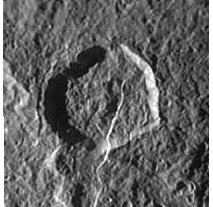
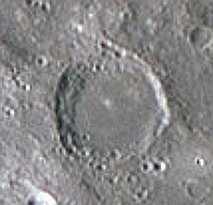
Dion on the left The Moon on the right
Both of the above craters were selected for their similarity in size (About 60 Km across) and for their position with respect to the terminator so that lighting conditions were constant. The floors of these craters are markedly different Dione’s being rough and granular whereas the Moon is much smoother. On the outside of the Dione crater little deformity of the surrounding surface from the crater’s formation can be seen. On the Moon however surface disruption is evident at the 7 and 9 o’clock positions. Along the eastern edge the ground seems to rise appreciably towards the crater rim.
11) From what you know or suspect about the way impact craters form, would you expect there to be a difference? Why?
There are many considerations that need to be taken into account when examining a crater. I have
listed some of them with their implications. Impacted body mass. Large mass bodies like our Moon have a higher gravity which causes
higher energy impacts. More massive bodies are more likely to retain ejector from the crater
formation.
Pages
<< | 1 | 2 | 3 | 4 | 5 | 6 | Next | >>