
Course Work BY R. A. Chaproniere
Navigation
HOMEPAGE
COURSES
 Exploring the Universe
Thu' a Small Telescope
Thu' a Large Telescope
Galaxies
Planetary Atmospheres
Planetary Geology
Modern Cosmology
Stars
Science Fiction???
PROJECTS
Essays
Observational Work
ABOUT ME
CONTACT ME 
Data Source :
Advertisement
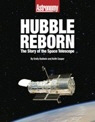 Hubble Reborn takes the reader on a journey through the Universe with spectacular full-colour pictures of galaxies, nebulae, planets and stars as seen through Hubble's eyes, along the way telling the dramatic story of the space telescope, including interviews with key scientists and astronauts.
Astonomy Now

Advertisement
John Moores University offers exciting distance learning courses in Astronomy ranging from an Introduction to Astronomy to Planetary Geology . You are sure to find something that interests you and want to know more about. If, like me, you've a lifelong interest in the subject or have been overwhelmed by the sheer beauty of the heavens then this is the place to start.
John Moores University
Assignment 6 (Craters)

Assignment 6 - Craters
Notes:
1) The distance data in the above table represents the required method for finding the diameter of the Herschel Crater. I have calculated
it taking into account a flat 2D representation together with the spherical 3D version.
2) Being unhappy with the accuracy of the my findings I went on to derive the angular positions of H1 - H4 using the formula from
the last assignment. Reducing the data to simple right angled triangles I calculated the hypotenuse of each, thus determining the
angular distance between H1/H2 and H3/H4. From the given diameter of Mimas (390km) I calculated the circumference from which
I was able to determine the actual distance of H1/H2 and H3/H4. Averaging them both out produced a figure I was more happy with.
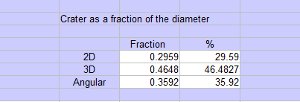 5) What fraction of the diameter of Mimas is the diameter of Herschel crater?
6) Try to find the centre of Dione from the image. Get as accurate an estimate of the radius of Dione
in pixels as you can. One method to estimate the radius is to go to a 'zoom' of 200% and adjust
the image so that you are viewing one 1/4 of the image.
radius in pixels
7) The actual radius of Dione is about 560 km. Now you can estimate the scale factor for this image
in the same way you did for the image of Mimas. scale factor = (radius in km)/(radius in pixels)

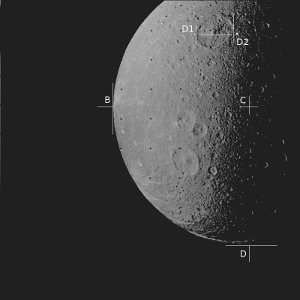 8) Scroll up the image as far as it will go. Look for the largest crater you can find, and estimate its
diameter in the same way you did for Herschel crater on Mimas.
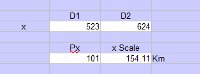
9) Which crater is larger, this one on Dione, or
Herschel on Mimas?
A) Dione
Which crater is larger IN PROPORTION TO
THE BODY IT IS ON?
A) Herschel on Mimas (Data Below)
Pages
<< | 1 | 2 | 3 | 4 | 5 | 6 | Next | >>