
Course Work BY R. A. Chaproniere
Navigation
HOMEPAGE
COURSES
 Exploring the Universe
Thu' a Small Telescope
Thu' a Large Telescope
Galaxies
Planetary Atmospheres
Planetary Geology
Modern Cosmology
Stars
Science Fiction???
PROJECTS
Essays
Observational Work
ABOUT ME
CONTACT ME

Course Work Completed
Assignment 1 [GoTo]
Assignment 2 [GoTo]
Assignment 3 [GoTo]
Assignment 4 [GoTo]
Assignment 5 [GoTo]
Assignment 6 [GoTo]
Assignment 7 [GoTo]
Assignment 8 [GoTo]
Assignment 9 [GoTo]
Assignment 10 [GoTo]
Assignment 11 [GoTo]
Assignment 12 [GoTo]
Advertisement
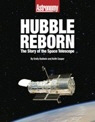 Hubble Reborn takes the reader on a journey through the Universe with spectacular full-colour pictures of galaxies, nebulae, planets and stars as seen through Hubble's eyes, along the way telling the dramatic story of the space telescope, including interviews with key scientists and astronauts.
Astonomy Now

Advertisement
John Moores University offers exciting distance learning courses in Astronomy ranging from an Introduction to Astronomy to Planetary Geology . You are sure to find something that interests you and want to know more about. If, like me, you've a lifelong interest in the subject or have been overwhelmed by the sheer beauty of the heavens then this is the place to start.
John Moores University
Galaxies

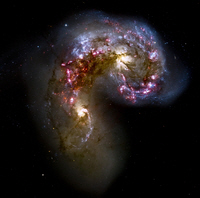 Galaxies: are groups of millions or billions of stars, and are central to our understanding of the Universe we live in. They provide the location for the birth, life and death of all stars, including our own Sun which lies in the Milky Way galaxy. On the largest scales, galaxies provide the latest particles used by cosmologists to map the side, expansion rate and evolution of the entire universe. This course will lead the student through the growth in our understanding of galaxies that occurred through both observations and theoretical insights throughout the 20th century, and will highlight the many intriguing mysteries remaining to be tackled by astronomers
Galaxy classification: Spiral, elliptical and dwarf galaxies. The Hubble 'Tuning fork' diagram and its development into modern classification systems.
Description of the typical contents of spiral and elliptical galaxies: Stars (young and old), gas (molecules, atoms and ultra-high-temperature plasmas), dust, magnetic fields, dark matter, black holes.
Multi-wavelength imaging of galaxies: Optical appearance of spiral and elliptical galaxies compared and contrasted with imaging at other wavelengths- radio, infrared, ultraviolet, x-ray and gamma-ray, What do these various wavelengths tell us? The disc of our Milky Way galaxy as a test case. What is spectroscopy, and what can it tell us about galaxies? Emission and absorption lines. what they are and where they come from. Spectral classification of young and old populations of stars, spectral indicators of star formation.
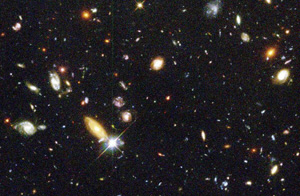 Distances and rotation rates of galaxies from spectroscopy: The Doppler shift. Galaxy redshifts and the expansion of the Universe. The Hubble constant. Galaxy rotation curves, gravitational attraction, and the evidence for missing mass in galaxies- 'Dark Matter'.
Star and Galaxy Formation: The types of galaxies which are still forming stars, and where this activity occurs within galaxies. Effects which trigger star formation, including spiral arms; near-misses, collisions and merging impacts between galaxies central bars; and supernova-triggered star formation. What do young galaxies look like, and what are the methods used to and them? Evidence for evolution in the properties of galaxies from the distant, early Universe to the present day.
The effect of environments on Galaxies: The link between galaxy shapes and the local environments in which they live. Possible effects of nearby neighbours on galaxies like our Milky Way- interactions, mergers, removal of gas, in fall of dwarf galaxies,- and how these processes shape the galaxies we observe.