
Course Work BY R. A. Chaproniere
Navigation
HOMEPAGE
COURSES
 Exploring the Universe
Thu' a Small Telescope
Thu' a Large Telescope
Galaxies
Planetary Atmospheres
Planetary Geology
Modern Cosmology
Stars
Science Fiction???
PROJECTS
Essays
Observational Work
ABOUT ME
CONTACT ME 
Data Source :
Advertisement
 Hubble Reborn takes the reader on a journey through the Universe with spectacular full-colour pictures of galaxies, nebulae, planets and stars as seen through Hubble's eyes, along the way telling the dramatic story of the space telescope, including interviews with key scientists and astronauts.
Astonomy Now

Advertisement
John Moores University offers exciting distance learning courses in Astronomy ranging from an Introduction to Astronomy to Planetary Geology . You are sure to find something that interests you and want to know more about. If, like me, you've a lifelong interest in the subject or have been overwhelmed by the sheer beauty of the heavens then this is the place to start.
John Moores University
Assignment 6 (Craters)

Assignment 6 - Craters

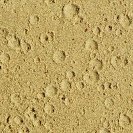

13) Why do you think so few meteorite craters are observed on Earth compared with other bodies
in the solar system?
Several causes conspire to erase the geological record of craters here on earth and perhaps the
most insidious is that of erosion. After an impact wind, rain and the cyclic freezing and thawing of
the seasons are quick, in a geological time scale, to remove every trace of all but the largest craters.
Life itself can also have an eroding effect as many smaller impacts are covered in vegetation.
Another cause, this time it stops the formation of craters in the first place, is our atmosphere. Many
impactors fail to make it to the surface and are burnt up as they hurtle through it. Most meteors are
an example of wanabe crater builders failing in their mission and burning up as they go. One very
obvious cause is the fact that our earth’s surface is 70% water and impacts into an ocean environment,
while devastating with the subsequent massive tsunamis etc, mean that the resulting crater
if one is formed is under the ocean surface and hidden from view. By far the most final of all causes
is plate tectonics. Where the surface crust is recycled at subduction zones. Craters on continental
crust that experience this are propelled under overlaying crust and are forced into the mantle
where they are melted and form an indistinguishable part of the make up of the planet.
14) Many large impact craters have peaks in their centres. How do you think these central peaks
formed?
 The kinetic energy in a large impact is truly vast and orders of magnitude
greater than the initial resistance of the impacted rock. It ceases to have
any strength and behaves like a fluid. At the moment of impact the main
The kinetic energy in a large impact is truly vast and orders of magnitude
greater than the initial resistance of the impacted rock. It ceases to have
any strength and behaves like a fluid. At the moment of impact the main
pit of the crater is excavated. Almost instantly the the material on the inside
of the crater walls begins to slump and move down towards the centre
of the depression. As it comes together at the centre it has no other
place to go but up and the ground rebounds forming a central mass that
solidifies into the central peak. A graphic illustration of this happening is in
the image on the previous page of a water droplet into water where the
central rebound can be clearly seen. All that is missing from this example
is a method of instantly freezing the example to make it permanent. The
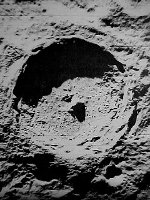
image on the left is of perhaps one of the youngest of the Moon’s carters -
Tycho with its central peak easily seen in the low attitude sunlight .
Pages
<< | 1 | 2 | 3 | 4 | 5 | 6 | Next | >>