
Course Work BY R. A. Chaproniere
Navigation
HOMEPAGE
COURSES
 Exploring the Universe
Thu' a Small Telescope
Thu' a Large Telescope
Galaxies
Planetary Atmospheres
Planetary Geology
Modern Cosmology
Stars
Science Fiction???
PROJECTS
Essays
Observational Work
ABOUT ME
CONTACT ME 
Data Source :
Star data from the Stars web-site Graphic from the Astralia telescope web-site
Advertisement
 Hubble Reborn takes the reader on a journey through the Universe with spectacular full-colour pictures of galaxies, nebulae, planets and stars as seen through Hubble's eyes, along the way telling the dramatic story of the space telescope, including interviews with key scientists and astronauts.
Astonomy Now

Advertisement
John Moores University offers exciting distance learning courses in Astronomy ranging from an Introduction to Astronomy to Planetary Geology . You are sure to find something that interests you and want to know more about. If, like me, you've a lifelong interest in the subject or have been overwhelmed by the sheer beauty of the heavens then this is the place to start.
John Moores University
Assignment 5 (Sun Spots)

To See Other Assignments in the Exploring the Universe Series: | 1 | 2 | 3 | 4 | 5 | 6 | 7 | 8 | 9 | 10 | 11 | 12 |
Briefly comment on the meaning of this uncertainty, and how important you think it might be.
In the Analysis an error of + or - 1 was returned and this typically would mean that at the limb of the disc an error of around 10,000 km is displayed, however at the centre an error of around 3,000 miles is to be expected.
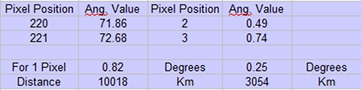 The problem with pixels and what they represent is the fact that they have size, they are not infinitely small. What makes the problem even greater is that in two dimensional representations of three dimensional spheres what they represent does not stay constant. Indeed the accompanying data demonstrates this quite graphically. Taking a pixel that is 95% out from the centre and on the equator represents 0.82° of arc, a distance of some 10,018 Km at the Sun’s surface whereas at the centre of the disc a single pixel represents just 0.25° of arc, a mere 3,054 Km. On average over the complete disc this represents <1% of error but with the vastness of the Sun and where actual structural dimensions are important to ascertain data like actual length, Area and the derivation of data like mass of a structure etc., then errors of this magnitude are critical. Another problem with size related pixels, when taking linear measurements, concerns the the angle of the measurement. Horizontal or vertical transition will give one result, travelling diagonally over a pixel will give a similar result but, thanks to Pythagoras, represent quite another. On low resolution images extreme care needs to be exercised when capturing data and the only hope for more accurate information is to use images with a high resolution
Another unrelated point which has significance for accuracy and that is the interval timing of when images are acquired. Most of the images in this exercise were taken at about 9.15 UT each day. One however was taken some six hours later than this (see data panel of image on a previous page). It is appreciated that averaging the difference over the six days helps to negate the error but this is only when a miss-timed image is in the middle of the range. If, on the other hand, it were at the beginning or the end of the range this error would be significant.
Pages
<< | Previous | 1 | 2 | 3 | 4 | 5 | 6 | >>